

About ServiceNow
ServiceNow is an IT service management (ITSM) platform that manages tickets, incidents, change requests, problems, and the service catalog. Connecting ServiceNow to Serval enables native bidirectional ticket sync, service-catalog import and ordering, knowledge-base sync (with optional mirroring of articles into Serval’s native knowledge base), and workflow automation across incidents, problems, changes, and HR cases. Each connection uses either OAuth 2.0 (client credentials) - the default and recommended option - or HTTP Basic authentication, and acts as a dedicated integration service account in your ServiceNow instance. Authentication: OAuth 2.0 (client credentials), or Basic auth Data sync: Bidirectional. Serval polls ServiceNow for ticket and comment updates (with an optional Business Rule webhook for near-real-time comment sync), keeps groups, roles, departments, companies, locations, and cost centers current with scheduled background syncs, can mirror synced knowledge articles into a read-only native Serval knowledge base, and writes back via the Table, Service Catalog, and Change Management REST APIs on demand when workflows run. Sync frequency is admin-configurable per sync.What the ServiceNow integration enables
Catalog import
Each catalog item is imported in one of three modes, chosen with the Collect inputs as control (and the split Import button) on the catalog import page:Improve with Catalyst
Every imported catalog item has an Improve with Catalyst action. It launches a Catalyst session pre-loaded with the item’s full captured understanding - variables, client scripts, UI policies, script includes, user criteria, and the imported workflow as a starting point - plus a built-in skill that reimagines the ITSM form as a conversational Serval experience: one orchestrating skill that asks only what the employee must actually decide, small collection workflows per branch, and a submit workflow that posts the request back to ServiceNow and links the resulting requested item to the ticket. There are two entry points: for natively importable items (“Turn this form into a conversation”), and for items too complex to import, where Catalyst redesigns around the client scripts and UI policies that block native import. Resources Catalyst builds stay attached to the catalog item under a Built with Catalyst list (with Skill/Workflow badges and an Unlink action), even after the session ends. This is the recommended path for items that were flagged link-only.Importing user criteria as access profiles
The User Criteria tab in the catalog import area imports ServiceNow user criteria as Serval access profiles. Pick a ServiceNow connection, click Sync user criteria to pull criteria from ServiceNow (progress is live-polled, and failures show error details with copyable run identifiers), then review each criterion and choose Import as access profile. The detail panel for each criterion shows:- Who it matches - groups, roles, user attribute conditions (attribute criteria such as department or location map to Serval access-profile attribute conditions), and individual users.
- What it makes requestable - the catalog items the criterion gates, including whether each link is an allow (“Available”) or deny (“Not available”) relationship.
- Proposed access profile - a preview of the Serval equivalent before you import.
Mirroring knowledge articles into Serval
Knowledge sync can do more than index articles for search: once syncing is enabled for a knowledge source, the source’s settings panel shows an Import to Serval Knowledge Base toggle (off by default). Its help text reads: “When enabled, synced articles from ServiceNow are also written into a Serval native knowledge base. Disable to stop syncing without deleting already-imported pages.” When enabled:- Mirrored knowledge bases appear in the Knowledge Bases sidebar under an External Connections section.
- Mirrored documents are sync-locked and read-only, with a banner - “This document is synced from ServiceNow and is read-only.” - and a View in ServiceNow link.
- Article HTML is converted to native editor blocks (tables, lists, and headings are supported), and the folder hierarchy from ServiceNow is preserved.
- Re-syncs update content in place and record version history.
- Clicking a knowledge item reference offers a destination choice: Open in Serval or Open in ServiceNow.
Sync settings: frequency and catalog filter
A Sync settings dialog - reachable from the app instance’s Workflow Sync settings and from the catalog import page - exposes two controls for catalog sync:- Catalog filter - an optional ServiceNow encoded query (for example
category=hardware^active=true). Only matching catalog items are imported; leaving it blank imports everything. The filter is combined (AND) with the standard active-items filter. This field appears only for integrations that support it - currently ServiceNow. - Sync frequency - Default (30 minutes), Every hour, Every 6 hours, Every 12 hours, Once a day, or Once a week.
- Portal path - which ServiceNow portal imported catalog items link back to. Choose Service Portal (
/sp, the default) or Employee Center (/esc), or enter a custom path. Changing it re-syncs the catalog so the links are regenerated; leaving Service Portal selected tracks the integration default rather than pinning a value. This control appears only for integrations that support it - currently ServiceNow.
- Unset means the platform default: catalog sync fan-out runs every 30 minutes for ServiceNow, and entity ingestion ticks every 4 hours.
- A configured interval is a floor, not an exact cadence - scheduled ticks are skipped until the interval has elapsed since the last completed sync. For entity syncs, values at or below 4 hours behave like Default (4 hours); only the 6-hour, 12-hour, daily, and weekly settings genuinely throttle.
How formatting translates to ServiceNow
ServiceNow journal fields (comments and work notes) and description/close-notes fields render plain text only, so everything Serval writes into them is automatically converted from Serval’s rich formatting to clean plain text. This applies to the built-in two-way ticket sync for all three ServiceNow ticket types - incidents, catalog requested items, and HR cases - covering ticket descriptions on create and update, and message bodies posted as comments or work notes.Copying ServiceNow attachments into Serval tickets
Custom workflows can move a file attached to a ServiceNow record onto a Serval ticket. Inside a single workflow action, download the attachment’s bytes through Serval’s integration connection using the SDK’s binary request helper, which uses your stored ServiceNow credentials and reads the file as raw bytes, then attach those bytes to the ticket as a message or internal note. Keep the download and the attach in the same action so the file itself never appears in the workflow’s run history; only the resulting attachment id does. Serval stores attachments up to 50 MB and refuses executables, installers, and scripts, so read each attachment’s size and file name from ServiceNow first and skip files that would be rejected. List a record’s attachments with a Table API query onsys_attachment filtered by table_name and table_sys_id, then copy them one at a time so a run that stops part-way resumes without duplicating files.
Finding the linked record in Serval
When a Serval ticket is synced to ServiceNow, its side panel shows a View in ServiceNow button with the ServiceNow record number (for example,INC0010001) beneath it. This lets an agent confirm at a glance which incident, catalog requested item, or HR case the ticket maps to before opening it.
How the connection works
Each ServiceNow connection acts as a dedicated integration user. Your team can connect multiple accounts to the same ServiceNow instance. You pick one of two authentication methods for each connection:- OAuth 2.0 (Client Credentials) - the default and recommended option. On each request, Serval exchanges your Client ID and Client Secret for a short-lived bearer token from your instance’s token endpoint (
https://<instance>.service-now.com/oauth_token.do) and sends that token on every API call. ServiceNow runs those calls as the OAuth Application User you designate (the same dedicated integration user described below), so that user’s roles and table ACLs determine exactly what Serval can do. Serval does not request any OAuth scopes - the token is bounded entirely by the integration user’s permissions, not by a scope list. - Basic authentication - Serval stores the integration user’s username and password and sends them as standard HTTP Basic auth on every call. Use this when inbound OAuth client credentials aren’t available on your instance, or for a quick test setup.
service-now.com - requests to any other host are refused before they leave Serval. Data flows both ways: Serval polls your instance for ticket and comment changes, keeps groups, roles, departments, companies, locations, and cost centers current with scheduled background syncs, and writes back (creating and updating incidents, problems, change requests, HR cases, and catalog requests) on demand when a workflow runs.
Get your credentials
You configure everything on the ServiceNow side first, then paste two values into Serval. The authoritative provider reference is the ServiceNow product documentation; the exact clickpath for inbound OAuth is in ServiceNow’s official guide, Enable OAuth with inbound REST.Create a dedicated integration user
Create a custom role for Serval
itil or admin. (The simpler OOB-role alternative is covered in the next step.)Grant table access via ACLs
com.snc.change_management.rest_api) - active by default on most instances.- Required Table Access
- Create ACLs
- Alternative: Use OOB Roles
Incident Management Tables
HR Service Delivery Tables
Required only if you sync or create HR cases.Service Catalog Tables
Configuration Tables (Read-Only)
Knowledge Base Tables (Read-Only)
User Criteria Tables (Read-Only)
These tables determine which users have access to knowledge articles and catalog items, and back the user criteria import.user_criteria, Serval reads every column that defines a criteria: active, advanced, match_all, script, sys_scope, and the seven condition columns user, group, company, department, location, role, and cost_center.Criteria Evaluation Tables (Read-Only)
Serval keeps ServiceNow user criteria in sync along two paths, and every sync uses both:- Fast path. Serval evaluates a criteria itself, against a read-only snapshot of your instance, in one pass, minutes after a sync starts. It needs read on the tables below. Every criteria the integration account lets Serval evaluate takes this path.
- Standard path. ServiceNow evaluates each remaining criteria for each user through the read-only Scripted REST endpoint you install (see Script-based knowledge permissions). It needs only the User Criteria Tables and the System Property ACLs on this page. On a large instance a full pass takes hours.
System Property ACLs (Read-Only)
Required for script-based knowledge permissions and for the fast path. Serval reads threesys_properties rows to decide how to fail on knowledge read criteria, and the fast path also reads every row that your criteria scripts pass to gs.getProperty(). Grant read on those rows the same way. sys_properties is not world-readable, and ServiceNow silently filters rows the user can’t read down to an empty result (a 200, not a 403) - so a missing grant looks identical to an unset property and can flip Serval to the wrong default. Grant read on exactly these three rows with record-level ACLs (Type record, Operation read, conditioned on name = the row below) rather than opening the whole table:Change Management Tables
com.snc.change_management.rest_api) to be active on your ServiceNow instance. This plugin is active by default on most instances.Problem Management Tables
Access Management & Resource Sync Tables
These tables are required if you use Serval’s access profile capabilities for syncing organizational resources and provisioning/deprovisioning users.sys_user and sys_user_group tables listed above under Configuration Tables still require read access for basic functionality regardless, and knowledge permission sync needs read on the identity tables listed under Criteria Evaluation Tables.Assign the custom role to the integration user
- Navigate to User Administration → Users and open the
serval.integrationuser - Scroll down to the Roles related list and click Edit
- Add the
x_serval_integrationrole (or the OOB roles if you chose that approach) - Click Save
(OAuth only) Enable the inbound client-credentials grant
sys_properties.list), find or create:(OAuth only) Create the OAuth Application Registry entry
- Recommended: New Inbound Integration Experience - the current UI for inbound OAuth, including client credentials. When the wizard asks Select your application connection type, choose OAuth - Client credentials grant (machine-to-machine). Do not choose Authorization code, JWT bearer, Resource owner password, or third-party ID token flows for the Serval integration.
- Alternative: [Deprecated UI] Create an OAuth API endpoint for external clients - the older wizard for the same kind of inbound app. “Deprecated UI” refers to ServiceNow replacing the screen flow, not to the credentials; it still produces a working Client ID / Client Secret. Some teams see odd default forms here (for example, the OAuth Application User field hidden until you change the form layout); using the New Inbound Integration Experience often avoids that.
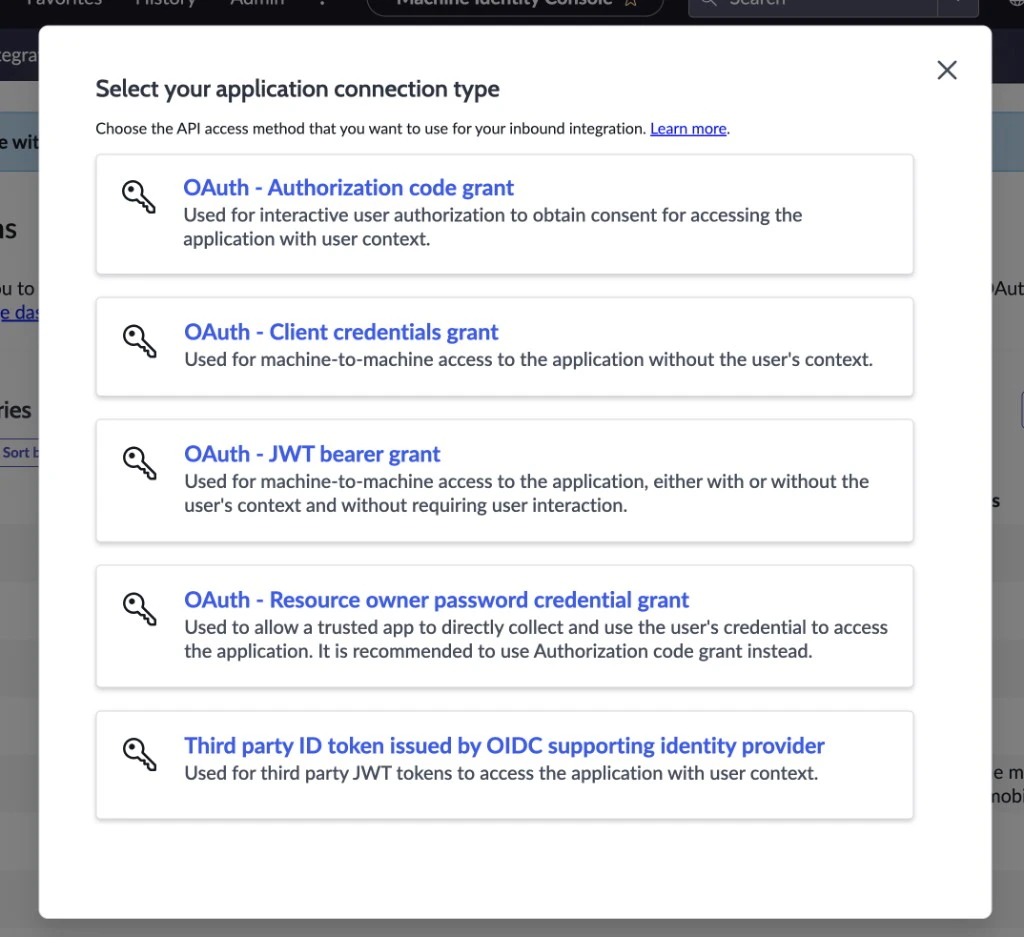
ServiceNow New Inbound Integration Experience: choose OAuth - Client credentials grant. The next steps in the wizard (or on the Application Registry record) are where you tie the app to your integration user for roles and auditing.
Serval integration) and save; ServiceNow auto-generates the Client Secret. Then:- Set Client type to run API calls as your integration account - for example Integration as a Service (wording varies by release). That tells ServiceNow which
sys_usersupplies roles, ACLs, and audit fields for requests made with a client-credentials token. - Allow the Client credentials grant. Often this is not on the main form: open the OAuth Entity or OAuth Entity Profile related list on the same Application Registry record, open the related row, and confirm Client credentials is enabled. Save that record if you changed it.
- Set the OAuth Application User to your
serval.integrationuser, so issued tokens act as that account.
(OAuth only) Copy the Client ID and Client Secret
Identify your ServiceNow Instance Name
https://mycompany.service-now.com, the instance name is mycompany. You’ll enter it in Serval next.Connect in Serval
In Serval, open Integrations → All integrations → ServiceNow → Connect and complete the form. The fields that appear depend on the Authentication method you pick.Enter your Instance Name
https://mycompany.service-now.com, enter mycompany.(Optional) Name the connection
IT Service Account, to distinguish accounts connected to the same ServiceNow instance. Leave it blank to use the instance name. The name is a display label; changing it doesn’t create a separate connection.Choose the authentication method and fill in credentials
- OAuth 2.0 (recommended)
- Basic authentication
(Optional) Enter the ACL Endpoint API Namespace

The optional ACL Endpoint API Namespace field on the ServiceNow connection screen.
Save the connection
Connect multiple accounts to the same instance
To add another connection, repeat the connection steps with the same Instance Name and a different Username for Basic authentication or Client ID for OAuth 2.0. Each account gets a separate connection with its own credentials. For OAuth, different client IDs create separate connections even if they use the same OAuth Application User. Connecting the same instance, authentication method, and username or client ID again updates the existing connection’s credentials. To rotate credentials or switch authentication methods while keeping the same connection, edit that connection instead of starting a new one. If you use Business Rule comment webhooks, enable them on only one ticket source per ServiceNow domain.Verifying the connection
Open the ServiceNow app’s API Integration tab and run the health checks. They confirm Serval can authenticate as your integration user and exercise the real surfaces it uses:- Test ServiceNow Connection - authenticates and queries your user table (a single row). Success reads “Successfully authenticated with ServiceNow”. Failure reads “Unable to connect to ServiceNow. Please verify your credentials are valid and have the necessary permissions.”
- List ServiceNow Users - samples up to ten rows from
sys_user. Success reports the sample size; failure reads “Unable to list users from ServiceNow. Please verify the credentials have permission to read the sys_user table.” - List ServiceNow Incidents, List ServiceNow Knowledge Articles, List ServiceNow Catalog Items, and List ServiceNow User Criteria - the same ten-row sample pattern against
incident,kb_knowledge,sc_cat_item, anduser_criteria. Each failure message names the table the credentials couldn’t read.
serval.integration user, creates a temporary incident whose short description begins with “Health Check Test Incident”, drives it through state transitions (New → In Progress → On Hold with a hold reason → In Progress), resolves it, creates additional short-lived incidents to exercise impact/urgency permutations (all resolved afterwards), and places a test catalog request against your first active catalog item, then closes the requested item. Test incidents are resolved, not deleted - seeing “Health Check Test” records appear and resolve is expected. The resolution-codes check fails if your instance has no resolution codes defined. The user lookup is hard-coded to the serval.integration user name - if you chose a different User ID in Get your credentials, this check fails at the user-lookup step even though the connection itself is healthy.Gotchas and troubleshooting
OAuth fails with access_denied / server_error
OAuth fails with access_denied / server_error
oauth_token.do - not a Serval storage problem. Work through these on the ServiceNow side, most common first:- Inbound client credentials enabled -
glide.oauth.inbound.client.credential.grant_type.enabledmust betruein Global scope. This is the number-one cause. - OAuth Application User set - the app must be tied to your integration user, and that user must be Active with the right roles/ACLs.
- Client credentials grant allowed - confirm it’s enabled on the app (or its OAuth Entity / Entity Profile record).
- Client ID / Secret correct - re-copy from ServiceNow with no leading or trailing spaces. If you rotated the secret in ServiceNow, update the Serval connection too.
The integration user doesn't appear in the OAuth Application User picker
The integration user doesn't appear in the OAuth Application User picker
Instance Name was rejected
Instance Name was rejected
mycompany (or paste the full URL and let Serval trim it) - don’t enter an IP, a non-service-now.com host, or extra path segments that aren’t part of the subdomain.'Required' validation errors when saving credentials
'Required' validation errors when saving credentials
- OAuth: “Client ID and Client Secret are required for OAuth 2.0” (or “Client ID and Client Secret are required when switching to OAuth 2.0” if you changed methods).
- Basic: “Username and Password are required for Basic Auth” (or “Username and Password are required when switching to Basic Auth”).
A write 'succeeds' (200) but the field didn't change
A write 'succeeds' (200) but the field didn't change
close_code, category, priority) silently ignore invalid values - the API returns 200 but the field stays empty, and a downstream Data Policy then blocks the state change. Valid choice values are instance-specific, so Serval’s helpers and workflows query them rather than hard-coding. If a workflow write isn’t sticking, the usual cause is an instance Business Rule, write ACL, or Data Policy on the target table - those are configured in ServiceNow and can’t be worked around from Serval.Change requests won't create or transition state
Change requests won't create or transition state
com.snc.change_management.rest_api) active. Most state transitions also require an assignment group to be set - set it at creation time, since adding it later is often blocked. Change approvals live in a separate table (sysapproval_approver), so the integration user needs write access there for approval workflows to work. A 403 from the Change Management API usually means a state-model condition isn’t met; a 400 naming a rule means a Business Rule is blocking.Knowledge, catalog, or access-profile syncs come back empty
Knowledge, catalog, or access-profile syncs come back empty
kb_* tables; empty catalog → check the catalog definition tables; empty access profiles → check the user_criteria and organizational tables. The matching health check (knowledge articles, catalog items, user criteria) will name the table it couldn’t read.Catalog sync fails or imports nothing after setting a catalog filter
Catalog sync fails or imports nothing after setting a catalog filter
A configured sync frequency doesn't seem to take effect
A configured sync frequency doesn't seem to take effect
Mirrored knowledge documents can't be edited or moved in Serval
Mirrored knowledge documents can't be edited or moved in Serval
A catalog item only imports as a link
A catalog item only imports as a link
A user criterion imports with warnings, or grants more access than expected
A user criterion imports with warnings, or grants more access than expected
Custom workflow writes show literal formatting markers in ServiceNow
Custom workflow writes show literal formatting markers in ServiceNow
Basic auth works but you want to move to OAuth (or vice versa)
Basic auth works but you want to move to OAuth (or vice versa)
Real-time comment sync via webhook (optional)
By default, Serval polls your ServiceNow instance to sync comments. For faster, near-instant comment delivery, you can configure a Business Rule that pushes new comments to Serval via webhook. This applies to comments on Incidents, HR cases, and Catalog Requested Items that were created by the Serval integration. When you connect multiple accounts to the same instance, enable Business Rule comment webhooks on only one ticket source for that ServiceNow domain. Use polling for the other connections. The domain identifies the destination, so Serval rejects a webhook if more than one enabled ticket source matches it. This restriction doesn’t apply to live-agent webhooks, whose URL identifies the connection.sys_journal_field table. No ServiceNow plugins, store apps, or additional licensing are required.How it works
When a comment is added to a Serval-managed record, an async insert Business Rule fires on thesys_journal_field table. The rule verifies the parent record was opened by the Serval service account (the dedicated integration user you created in Get your credentials), constructs a JSON payload, and sends it asynchronously to the Serval webhook. Serval processes the event and delivers the comment to the relevant conversation in real time - entries on the comments field surface as public replies, entries on work_notes surface as internal notes.
incident, sn_hr_core_case, and sc_req_item records.Get your webhook token
The webhook carries a per-environment token that Serval provides during onboarding, sent in theX-Serval-Webhook-Token header (server-side verification of this token is on the roadmap; the token is forwarded with each event today). Contact support@serval.com to obtain your token before creating the Business Rule. For production, store it in a System Property (for example x_serval.webhook_token) rather than hard-coding it in the script.
Webhook endpoint
Payload reference
Payload reference
record_sys_id, comment.sys_id, and a parseable instance_url are required; Serval routes the event to your integration install by the instance domain.Create the Business Rule
Navigate to Business Rules
Configure the rule settings
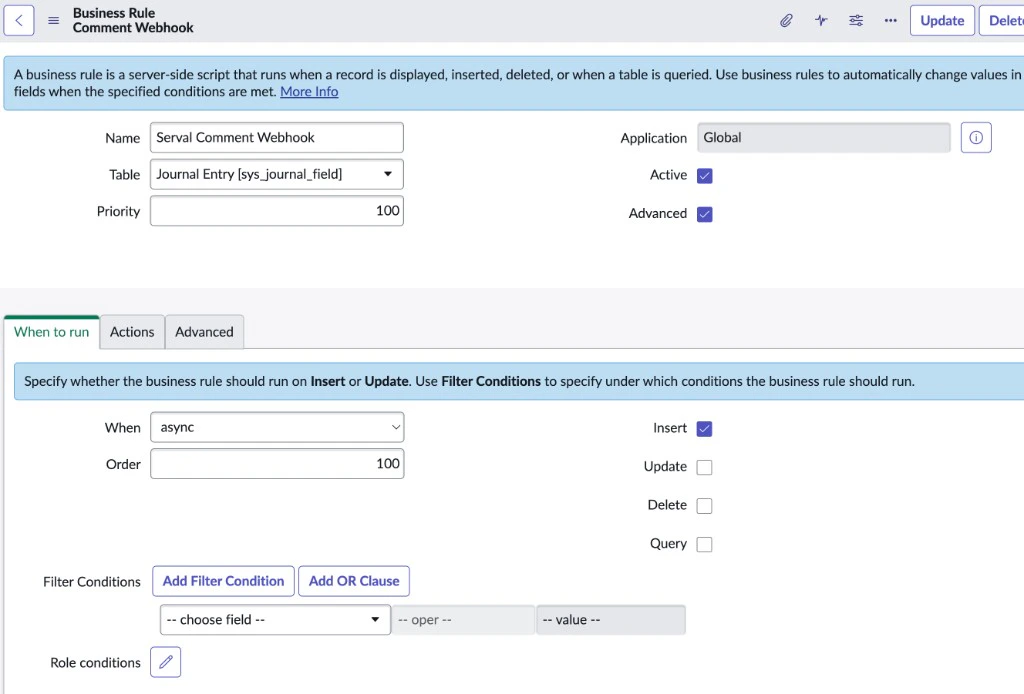
Business Rule settings on the 'When to run' tab
Add the script
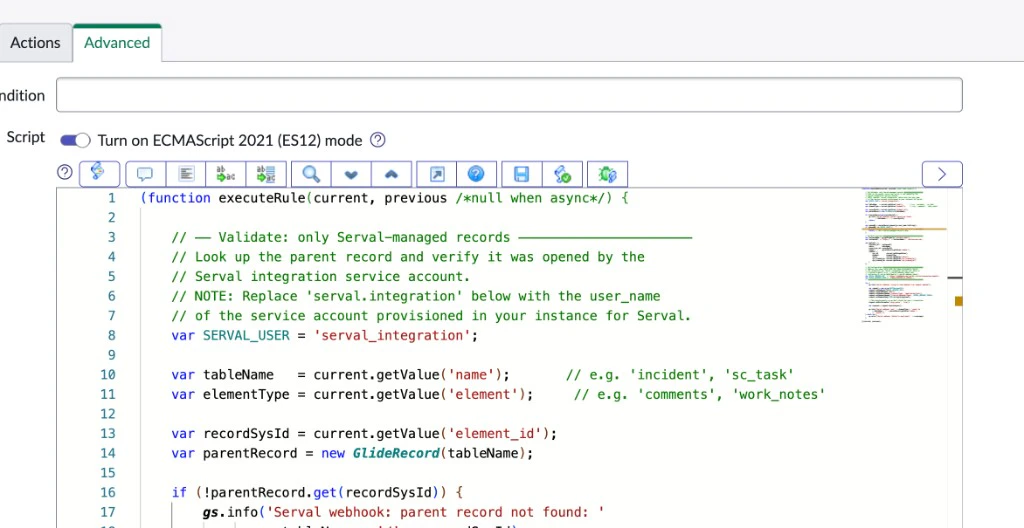
The Advanced tab with the webhook script
Save the Business Rule
Script-based knowledge permissions (optional)
ServiceNow gates knowledge articles with user criteria - including script-based (“Advanced”) and “Match All” criteria - that decide who is allowed to read each article. Serval honors those same rules along two paths, and every sync uses both.- Fast path: Serval evaluates. Serval evaluates a criteria itself, against a read-only snapshot of your instance, whenever the integration account can read what the criteria needs. That needs the read grants listed under Criteria Evaluation Tables.
- Standard path: this endpoint. For every other criteria, Serval asks ServiceNow itself which users match, through a small read-only Scripted REST API you install on your instance. Serval never parses or reimplements your criteria scripts on this path; ServiceNow evaluates them with its own engine and returns the result, which Serval syncs. It needs no read grants beyond the User Criteria Tables and System Property ACLs. Serval also uses this endpoint to re-check the fast path’s answers on a rotating page of users.
Prerequisites
- Knowledge sync is already configured for this ServiceNow connection (see the knowledge base setup earlier on this page).
- The Serval service account has the read grants from Get your credentials - the User Criteria Tables plus the three System Property ACLs described there. Those grants are what let the endpoint (and the knowledge read-criteria fail-closed logic) work correctly, so set them up first.
- If your instance uses domain separation, the Serval service account must be in the global domain. A domain-restricted account sees only a slice of the user and group tables, so the endpoint refuses to compute criteria membership for such an account (it reports every criteria as errored and Serval keeps the last known access state) rather than risk hiding articles from the wrong people.
Create the Scripted REST API
Create the Scripted REST API
Add the matching_criteria POST resource
Restrict the endpoint to the Serval service account
Create an ACL on the resource operation so only the Serval service account can call it. Restrict the REST endpoint (thesys_ws_operation ACL) to the role you assigned to your Serval integration user in Get your credentials.
Copy the API namespace into Serval
Open the Scripted REST API form (System Web Services → Scripted REST APIs → Serval ACL) and read the API namespace value ServiceNow assigned. On a global-scope install this is your instance’s global namespace - typically your bare instance number (for example2191009) or a value like x_1234567_serval, not x_serval. The endpoint’s full route is POST /api/<namespace>/serval_acl/matching_criteria.
Copy that namespace, then in Serval open Integrations → All integrations → ServiceNow → Connect (or edit the existing connection) and paste it into the ACL Endpoint API Namespace field.

Read the API namespace off the Scripted REST API form, then paste it into the ACL Endpoint API Namespace field on the Serval ServiceNow connection screen.
Verify
Call the endpoint as the Serval service account with a known user and criterion:200 whose body carries a serval_acl_version and a matches map. matches["<user_sys_id>"] contains <criteria_sys_id> exactly when that user matches that criterion in the native Knowledge portal. A 400 reading “Requested URI does not represent any resource” means the namespace or API ID is wrong, or the resource isn’t installed - recheck the steps above and the namespace you gave Serval.
Then verify the bulk evaluation mode Serval’s sync uses on large instances:
200 echoing "mode": "matching_users" whose criteria_members["<criteria_sys_id>"] lists the users that criterion matches. A response without the mode echo means the pasted script is an earlier version - re-paste the script above.
In Serval, article visibility reflects the newly evaluated criteria after the next knowledge sync completes: articles that were hidden because they were gated by script-based criteria become answerable for the users ServiceNow says can read them.
Limitation: caller-scoped criteria scripts
Live agent handoff via VA Bot-to-Bot (optional)
Serval can hand a conversation off to a human ServiceNow agent mid-flow, then bridge the agent’s replies back into the Serval ticket so the user keeps chatting in their original surface (Slack, Teams, web, etc.). This rides on ServiceNow’s native Virtual Agent Bot-to-Bot APIs. The handoff itself doesn’t require a Serval-shipped update set or a Scripted REST API. Setup on the ServiceNow side is roughly: install the Virtual Agent API plugin (if not already installed), grant the Serval service account a few additional permissions, create a Token Verification + Message Auth + Provider Application + Outbound REST Message pointing at a Serval-hosted webhook URL, and (optionally) tune the AWA routing for the chat channel you want to use for the handoff. Install a read-only Scripted REST API only if the Serval workflow must check availability for a route that depends on skills, country, language, or other customer-specific rules before it starts the handoff.subtype = "interaction" on the existing ServiceNow integration - they do not create a separate integration or channel type. The auto-created interaction record on the ServiceNow side is the same record type ServiceNow uses for all VA-mediated chats.How the bridge works
The bridge has three legs:- Inbound to ServiceNow - Serval opens, sends messages on, and ends a Bot-to-Bot conversation by calling ServiceNow’s Virtual Agent Bot Integration endpoint (installed by the Virtual Agent API plugin). The action discriminator travels in the request body:
START_CONVERSATION,AGENT_CHAT, orEND_CONVERSATION. - Outbound from ServiceNow - when the live agent types a reply, ServiceNow’s Provider Application looks up its associated Outbound REST Message and POSTs the response to the URL you configured there. That URL is the Serval-hosted webhook.
- Availability pre-flight (optional) - for simple channel routing, Serval can read the
awa_agent_presence_capacitytable to check whether any agents are online. For customer-specific routing, Serval can send the intended route to a read-only evaluator on the ServiceNow instance.
channelIdon the start action - maps to a ServiceNowsys_cs_channelrecord. Defaults to"chat". The channel record’s “Bot to Bot Synchronous” flag and its AWA queue assignment together determine where the conversation routes.contextVariableson the start action - a free-form key/value bag passed to ServiceNow on every turn. Customers configure their AWA routing rule against the variable name(s) of their choice (e.g.u_liveagent_optional_skills). See Customize routing with context variables below.
Prerequisites
- Virtual Agent + Virtual Agent API plugins installed on your ServiceNow instance (Quebec or later).
- The Serval ServiceNow integration must already be connected (everything above on this page).
- Now Assist Pro licensing is not required - Bot-to-Bot is part of the base Virtual Agent API plugin.
Limitations (read before you commit)
- Closing a Serval ticket does not automatically end the ServiceNow conversation. Your workflow should call the end-session action when the ticket resolves if you want symmetric cleanup. The conversation eventually times out on the ServiceNow side either way.
- Agent attribution is automatic; assignment details are not. ServiceNow’s Bot-to-Bot payloads carry per-message agent information, and Serval resolves it to the ServiceNow user - so agent replies are attributed correctly on the Serval ticket with no extra work. What the asynchronous START acknowledgment does not tell you is which queue the conversation landed in or when an agent picked up; poll the auto-created
interactionrecord’sassigned_tofield from a workflow if you need that - see the example workflow below. - Inbound auth verification is currently advisory. The Basic-auth password on inbound webhooks is forwarded onto the event for downstream verification, but the constant-time check against the rotated token is not yet enforced server-side. The per-install webhook URL contains an unguessable UUID, which is the practical access control today. Treat the rotated token as a not-yet-load-bearing secret in the meantime - full server-side verification is on the roadmap.
- Attachments require trusted-media-domain configuration. Files do cross the bridge in both directions, but ServiceNow refuses to download attachments from URLs whose host isn’t listed under the active Provider Application record’s Trusted media domains (the
sys_cs_provider_applicationrecord - labeled Provider Channel Identity on some releases). You must add Serval’s S3 attachment host (the host of the presigned URL Serval sends for attachments - visible on a test egress) to that list, otherwise the live agent will see “We couldn’t download your file using the specified URL” instead of the image. See the ServiceNow docs: Set up trusted media domains for secure file upload for the field and ACL setup. - Word and Excel uploads require interaction enrichment. ServiceNow’s Bot-to-Bot endpoint rejects modern Office MIME types, so Serval uploads them to the backing
interactionrecord instead. Include the post-START interaction poll andattachInteractionSysIdToLiveAgentSessionstep below when these file types must be supported. An upload that races that enrichment is deferred and retried after the sys_id is stored.
What agent replies look like on the Serval ticket
Three kinds of inbound items surface on the bridged ticket; everything else (topic pickers and other Virtual Agent scaffolding) is accepted and dropped:- Agent text surfaces as a comment, attributed to the ServiceNow agent.
- Agent images and files from ServiceNow’s conversational media and attachment endpoints surface as attachments. Generic
OutputLinkredirects remain text links and are never downloaded. Downloads use your stored integration credentials, do not follow redirects, and are capped at 50 MB per file. If a download fails, Serval posts the placeholder comment[attachment <name> could not be downloaded - please refresh ServiceNow Agent Workspace]instead of failing the whole message. - System prompts (such as AWA idle-timeout warnings) surface as comments so the user can reply and keep the chat alive.
Step 1: Grant additional permissions to the Serval service account
The standard Serval ACLs cover the Table API surface used by the rest of the integration. Live Agent needs two additional ServiceNow roles plus reads on the AWA tables and theinteraction table. Add these to your Serval service-account user:
Roles:
Type: record, Operation: read, Requires role: x_serval_integration or whichever role you assigned to the Serval service account):
Step 2: Generate the shared bot token in Serval
In your Serval workspace, navigate to Integrations → ServiceNow → Ticket Syncing. Scroll to the Live Agent (VA Bot-to-Bot) section and click Generate token. You’ll see three values you’ll need in the next step:- The Token Verification record. Serval injects this value into the body of every Bot-to-Bot call; ServiceNow’s Message Auth middleware verifies it before processing.
- The Outbound REST Message Basic-auth password. ServiceNow presents this value when posting agent replies to the Inbound Webhook URL above.
Step 3: Configure the four ServiceNow records that wire up Bot-to-Bot
ServiceNow’s Bot-to-Bot setup links four records together. The record names below are the OOB tables - the navigation labels may vary slightly by release.Enable inbound auth on the VA Bot Integration Scripted REST API
Create the Token Verification record
token_verification.list and press Enter. Click New. Fill in:Create the Message Auth record
message_auth.list and press Enter. Click New. Fill in:Create the Provider Application
sys_cs_provider_application.list and press Enter. Click New. Fill in:third_party_chat and Value true. On Virtual Agent API v4 or later, this makes ServiceNow store Serval’s clientSessionId on the Interaction record and include the Interaction sys_id as interactionId in callback payloads. Without it, cross-system reporting cannot reliably join the two records.Create the Outbound REST Message
REST Message and open the table. Click New. Fill in:post with:Verify the chat channel is Bot-to-Bot enabled
sys_cs_channel.list and press Enter. Find the channel you intend to route through (the OOB one is named chat - its sys_id is what you’ll pass as channelId from your workflows; the literal string "chat" also works on most releases).On the channel record, confirm Bot to Bot Synchronous = true. If it’s not, set it and save. Without this flag, the bot integration endpoint will reject START_CONVERSATION calls with a routing error.- The Token Verification record’s
Tokenfield. - The Basic Auth profile used by the Outbound REST Message (or, if you embedded the password directly on the REST Message, update it there).
Step 4: SDK building blocks
The ServiceNow SDK exposes six thin building-block actions for live agent. They are intentionally not orchestration helpers - live-agent flows vary enough between customer ServiceNow configurations (different chat experiences, custom AWA routing rules, renamed topics, varying trigger phrases for NLU) that workflow authors compose these directly rather than configure a single high-level wrapper:checkLiveAgentAvailability- channel-level pre-flight: are any human agents online right now? Reads the agent-presence capacity table and returns whether agents are available plus a queue-depth figure (the sum of agents’ remaining capacity). Use this when the channel is sufficient to identify the agent pool.checkLiveAgentRouteAvailability- route-level pre-flight: sends the user, message, channel, context variables, and provider application to a customer-installed, read-only ServiceNow evaluator. Use this when agents share a channel but AWA routes by skills, country, language, or other customer-specific rules.startLiveAgentSession- opens a conversation. The caller supplies the ServalticketId, the user (a ServiceNowsys_usersys_id is preferred, plus email), the verbatimmessagetext (including any NLU trigger phrase),channelId(defaults to"chat"),contextVariablesfor routing (re-sent on every turn), and optionallyappInboundIdfor multi-bot instances.connectTicketdefaults to true, which wires the ServiceNow conversation onto the Serval ticket as aninteraction-subtype external ticket so user replies auto-egress asAGENT_CHATturns. It returns the session identifiers - includingclientSessionIdand aliveAgentDatablob that the attach action below consumes.sendLiveAgentMessage- manually sends anAGENT_CHATturn. Usually not needed: once the ticket is connected, user replies auto-egress through the standard pipeline. Use it for programmatic messages (auto-replies, scripted status updates, testing).endLiveAgentSession- force-ends a session (e.g. on ticket resolve, user abandon, or SLA timeout).attachInteractionSysIdToLiveAgentSession- manually stashes a polledinteractionsys_id when an older ServiceNow Virtual Agent API callback does not includeinteractionId. Virtual Agent API v4 callbacks are captured automatically.
Step 5: Customize routing with context variables
contextVariables is the principal knob for AWA routing. The variable names you pass are customer-specific - they must match the conditions on whichever AWA routing rule you’ve configured on your ServiceNow instance.
For example, an “IT Live Agent Chat” queue whose routing rule has the condition context.u_liveagent_optional_skills = IT is targeted by passing a u_liveagent_optional_skills context variable with the value IT. Other instances might use u_skill_required, routing_skill, or any other custom variable name. To find the right variable name on your instance, check your AWA routing rule’s condition script, or ask your ServiceNow admin.
Custom interaction-record fields (e.g. CMDB tag, custom assignment-group overrides, region routing) can also be projected onto the auto-created interaction record via a ServiceNow-side Business Rule that reads the contextVariables payload. This is a pure ServiceNow-side customization - no Serval changes required.
Check availability for the exact route
ServiceNow doesn’t provide a documented, read-only API that previews the result of arbitrary AWA routing rules. If a workflow must hide the live-agent option unless an agent matches the exact route, create a read-only Scripted REST API resource on the ServiceNow instance. The resource owns the customer-specific evaluation and exposes a stable contract to Serval. Configure the resource to accept this request body:result envelope:
agentsAvailable is required. queueDepth and reason are optional. Require authentication on the resource and authorize only the Serval service account or its dedicated role. The resource must only inspect routing and capacity; it must not create an AWA work item, interaction, or conversation.
Build the route once in the Serval workflow and pass the same values to the availability and start actions:
startLiveAgentSession, the ServiceNow administrator can change the local routing model without adding customer-specific parameters to the Serval SDK. Update the evaluator and AWA rules together whenever the ServiceNow routing inputs change.
Step 6: Example workflow - START_CONVERSATION with routing and assignment poll
This mirrors the canonical pattern verified end-to-end against a real ServiceNow instance. You can drop this into a Serval workflow as a starting point and adapt the routing skills, trigger phrase, and message composition to your environment.- User → agent: any new message the user sends in their original surface fans out to the ServiceNow agent automatically as an
AGENT_CHATturn - no extra workflow code required; Serval’s ticket-channel egress handles it. - Agent → user: ServiceNow’s Outbound REST Message posts the agent’s typed reply to the Inbound Webhook URL configured in Step 3. Serval ingresses it as a comment on the bridged ticket (attributed to the agent), which surfaces back in the user’s original surface.
Step 7: Optionally end the session symmetrically
When the Serval ticket auto-resolves or the user abandons, callendLiveAgentSession with the clientSessionId saved from the START workflow output, the same user, a short reason such as ticket_resolved, and the same channelId (and contextVariables, if your routing rule expects them on every turn).
This is best-effort - the ServiceNow side eventually times the conversation out either way, but an explicit END_CONVERSATION cleans up the interaction record faster and gives the agent a clean “user ended chat” signal.
Step 8: Real-time translation (optional)
Live agents and end users frequently speak different languages - a Spanish-speaking employee opens a chat in Slack, the routed IT queue is staffed by English-speaking agents, and you want both sides to read their own language without the agent having to copy/paste into a translation tool. To enable bidirectional real-time translation for the lifetime of a conversation, pass two extra fields onstartLiveAgentSession: userLanguage (a BCP-47 code for the requester, e.g. es) and agentLanguage (the code your live agents read and write, e.g. en).
What changes after that:
- User → agent. Every message the user types on the upstream surface is translated from
userLanguageintoagentLanguagebefore it lands as anAGENT_CHATturn on ServiceNow. - Agent → user. Every reply the live agent posts is translated from
agentLanguageintouserLanguagebefore it’s persisted on the Serval ticket and fanned back out to the user’s surface.
- Both fields must be set. If either is omitted, or both share a primary subtag (e.g.
envsen-US), the conversation runs through verbatim - no translation is attempted. - URLs, code blocks, ticket numbers, and @mentions are preserved verbatim across the translation.
- Translation failures fall back to the original text and log a warning. A passthrough turn is strictly better than a dropped turn on a live chat - the agent or user can ask the other side to rephrase.
- Translation is handled by Serval automatically - there is nothing to configure on the ServiceNow side.
userLanguage. If userLanguage is unknown, no translation is attempted in either direction.
Need help? Contact support@serval.com for assistance with your ServiceNow integration - including custom routing-rule design, multi-bot Provider Application setups, interaction-field Business Rules, and real-time translation rollouts.