> ## Documentation Index
> Fetch the complete documentation index at: https://docs.serval.com/llms.txt
> Use this file to discover all available pages before exploring further.
# Access Profiles
> Define which users can request specific roles based on group membership
Access profiles ensure only users in designated groups can request access to particular roles. This prevents unauthorized access requests and maintains security boundaries across your applications.
***
## Understanding Access Profiles
Access profiles answer the question: "Who is allowed to request this role?"
They work by mapping Serval groups to roles. When a user requests access, Serval checks whether they belong to a group that's allowed to request that role.
**Example:** You can create an "Engineering" profile that only allows members of your engineering teams to request access to production databases.
Configure the following settings to define which users can request specific roles:
The user group identifier from Serval. Must match existing Serval group naming conventions.
Optional context about the profile's purpose, target user population, or usage guidelines.
Additional Serval groups included in this access profile. Use this to combine multiple groups under a single access policy.
IdP groups linked to this profile. These determine which roles become requestable for users matching this profile.
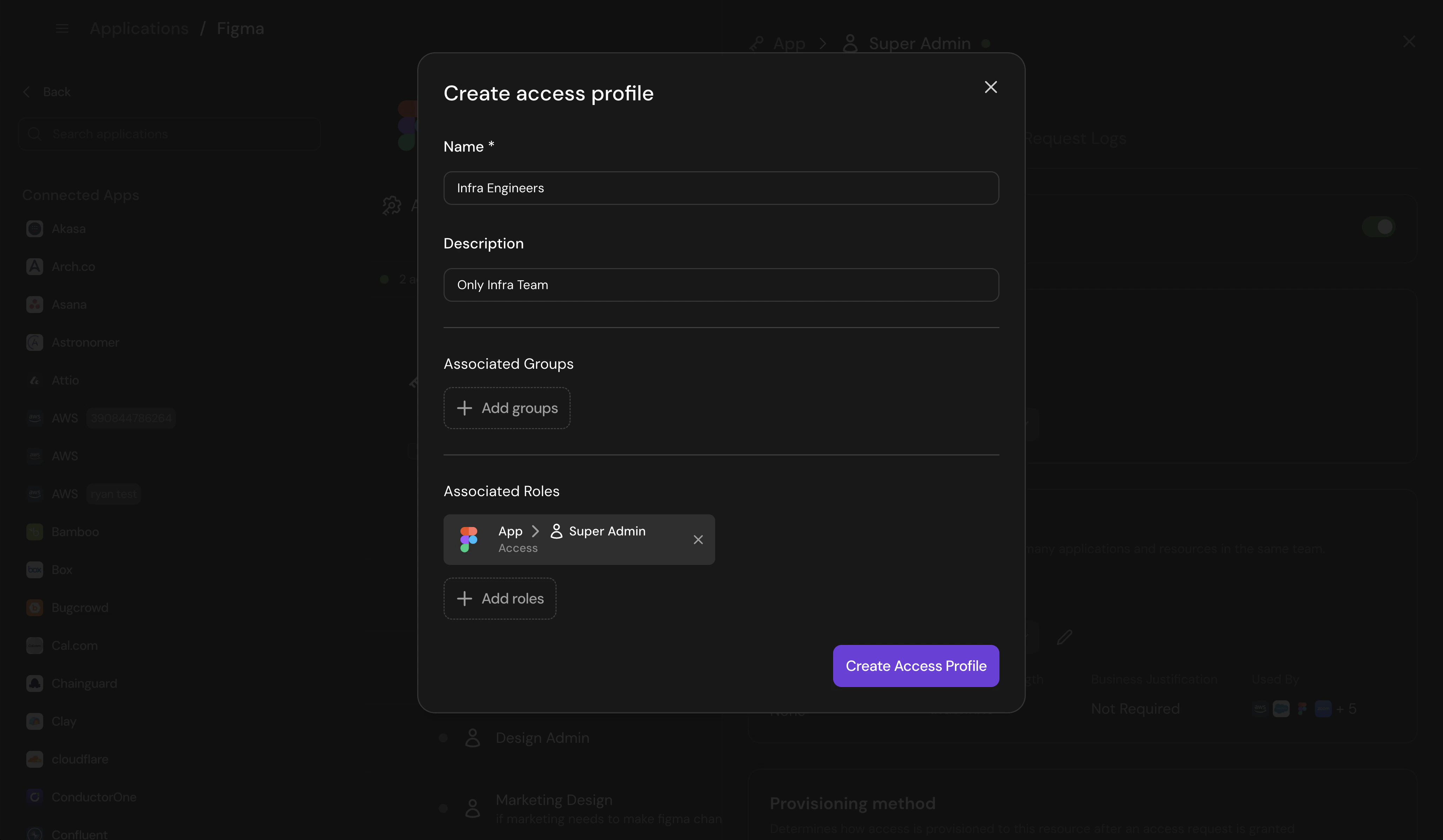
## Profile Configurable in the Application
 ***
## Create an Access Profile
**Name:** The user group identifier from Serval. Must match existing Serval group naming conventions.
**Description:** Optional context about the profile's purpose, target user population, or usage guidelines.
**Associated Groups:** Additional Serval groups included in this access profile. Use this to combine multiple groups under a single access policy.
For example, combine "Engineering-Frontend" and "Engineering-Backend" groups into a single "Engineering" profile.
**Associated Roles:** IdP groups linked to this profile. These determine which roles become requestable for users matching this profile.
Click "Save profile" to make it available for role configuration
***
## Manage Access Profiles
Once created, access profiles can be managed centrally and applied to multiple roles across your organization.
To access profile management, navigate to the relevant team, click the "..." button, then select "Access Profiles."
### What You Can Do
Choose a default profile that applies to new roles automatically. This is typically your broadest user group (e.g., "All Employees").
Modify profile settings. Changes apply to all roles using that profile, making it easy to update access permissions organization-wide.
See which roles currently use each profile. This helps you understand the impact before making changes.
Add or remove roles that the profile should apply to. Reuse profiles across similar access patterns for consistency.
***
## Profile Examples
**Groups:** company-all-employees\
**Purpose:** Standard company-wide applications like Slack, Google Workspace
**Use for:** Access that every employee should be able to request
**Groups:** eng-frontend, eng-backend, eng-infrastructure\
**Purpose:** Engineering tools and production access
**Use for:** Developer tools, code repositories, staging environments
**Groups:** finance-accounting, finance-payroll\
**Purpose:** Financial systems and sensitive data
**Use for:** Accounting software, payment processors, financial dashboards
**Groups:** contractor-engineering, contractor-design\
**Purpose:** Limited access for external workers
**Use for:** Non-sensitive tools and resources appropriate for contractors
***
## Best Practices
Create profiles that mirror your actual organizational structure. This makes it intuitive for admins to assign the right profiles.
Create an "All Employees" profile for widely-used applications. This reduces administrative overhead.
Group teams with similar access needs together. For example, all engineering groups can share an "Engineering" profile.
Write clear descriptions so admins understand when to use each profile when configuring new roles.
***
## Create an Access Profile
**Name:** The user group identifier from Serval. Must match existing Serval group naming conventions.
**Description:** Optional context about the profile's purpose, target user population, or usage guidelines.
**Associated Groups:** Additional Serval groups included in this access profile. Use this to combine multiple groups under a single access policy.
For example, combine "Engineering-Frontend" and "Engineering-Backend" groups into a single "Engineering" profile.
**Associated Roles:** IdP groups linked to this profile. These determine which roles become requestable for users matching this profile.
Click "Save profile" to make it available for role configuration
***
## Manage Access Profiles
Once created, access profiles can be managed centrally and applied to multiple roles across your organization.
To access profile management, navigate to the relevant team, click the "..." button, then select "Access Profiles."
### What You Can Do
Choose a default profile that applies to new roles automatically. This is typically your broadest user group (e.g., "All Employees").
Modify profile settings. Changes apply to all roles using that profile, making it easy to update access permissions organization-wide.
See which roles currently use each profile. This helps you understand the impact before making changes.
Add or remove roles that the profile should apply to. Reuse profiles across similar access patterns for consistency.
***
## Profile Examples
**Groups:** company-all-employees\
**Purpose:** Standard company-wide applications like Slack, Google Workspace
**Use for:** Access that every employee should be able to request
**Groups:** eng-frontend, eng-backend, eng-infrastructure\
**Purpose:** Engineering tools and production access
**Use for:** Developer tools, code repositories, staging environments
**Groups:** finance-accounting, finance-payroll\
**Purpose:** Financial systems and sensitive data
**Use for:** Accounting software, payment processors, financial dashboards
**Groups:** contractor-engineering, contractor-design\
**Purpose:** Limited access for external workers
**Use for:** Non-sensitive tools and resources appropriate for contractors
***
## Best Practices
Create profiles that mirror your actual organizational structure. This makes it intuitive for admins to assign the right profiles.
Create an "All Employees" profile for widely-used applications. This reduces administrative overhead.
Group teams with similar access needs together. For example, all engineering groups can share an "Engineering" profile.
Write clear descriptions so admins understand when to use each profile when configuring new roles.